A laser cut has a width. The beam burns material away on both sides of every path, so each edge of a slot loses half the kerf — K/2 — and everything about fit follows from that one subtraction. The kerf & fit guide builds the whole system from it: a measure, an offset rule, and a printed gauge that stops the guessing.
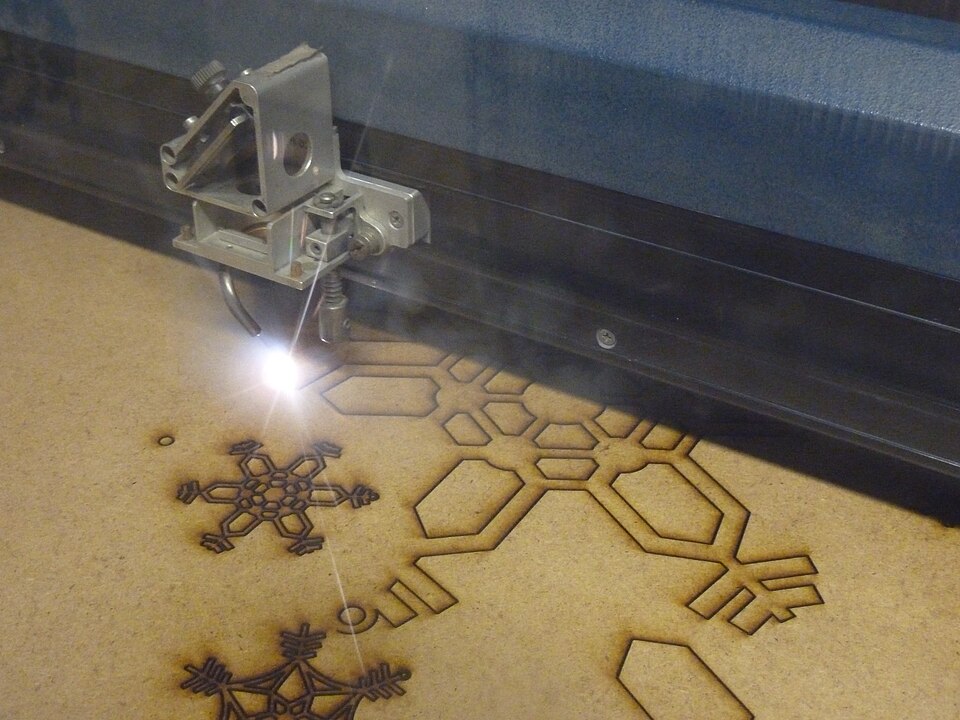
Measuring it: ten squares
The app's method is a ruler. Cut N squares of side S, push them end to end along the line, and measure the true total length M. The kerf falls straight out:
K = S − M / N
The guide's worked default: ten squares of 20 mm draw 200 mm on the sheet, but measure 198.4 mm pushed together — K = 20 − 19.84 = 0.16 mm. One number, and every joint decision afterwards comes from it.
Using the number
A slot drawn at the tab's width T with a desired clearance c comes out at T + c − K; a tab grows by + K. If your software carries a kerf offset (LightBurn's does), you give it K/2 and it moves paths outward on outer shapes, inward on holes — the same compensation, held on the software's side.
The gauge instead of the guess
The clearance question — how loose should the slot be? — the app answers by printing the question's answer: ten slots from T − 0.25 mm to T + 0.20 mm in 0.05 mm steps, cut with the offset off, teeth 4 mm on a score layer, digits in seven-segment strokes. Press each slot until one fits, and the real clearance reads directly: c = the slot that fit + K − T. The gauge's own teeth were cut by the same beam, so its fit is the truth — and the app ships no default clearance at all: zero is a press fit, and the gauge measures everything else.
One last honesty from the guide, titled in its own words: "3 mm" is a mood, not a size. Sheet sold as 3 mm varies by tenths of a millimetre, and "3 mm" Baltic birch sold in the US often measures 1/8 inch — 3.18 mm. Caliper the actual sheet, then cut the gauge for that number.
Cut the ten squares, read the gauge, and cut what fits. — the bench crew

